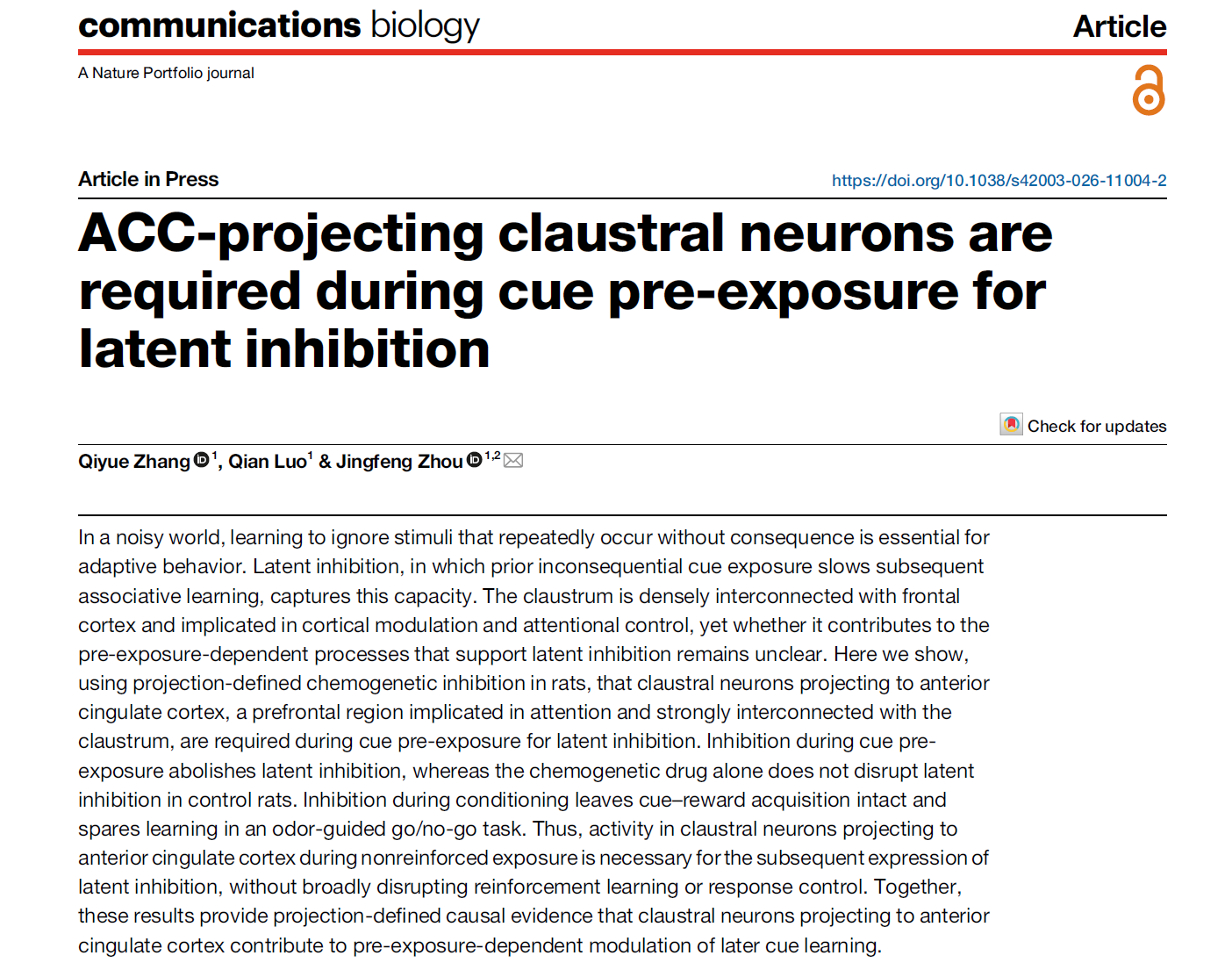
Qiyue’s paper, published in Communications Biology, reveals that claustral neurons projecting to the anterior cingulate cortex (ACC) are required during cue pre-exposure for latent inhibition, a form of learning in which prior exposure to an inconsequential stimulus slows subsequent associative learning.
Summary
Learning to ignore irrelevant stimuli is essential for adaptive behavior. This process can be studied through latent inhibition, whereby repeated exposure to a stimulus without consequences reduces the rate at which new associations involving that stimulus are subsequently learned. However, the neural circuits supporting this process remain incompletely understood. In this study, we used projection-specific chemogenetic inhibition in rats to investigate the role of claustral neurons projecting to the ACC. We found that inhibiting these neurons during nonreinforced cue pre-exposure abolished latent inhibition. In contrast, inhibition during subsequent conditioning did not impair cue–reward learning. Additional control experiments confirmed that the effects were not attributable to the chemogenetic drug alone or to a general disruption of associative learning.
These findings provide causal evidence that ACC-projecting claustral neurons contribute to the processing of previously inconsequential stimuli, highlighting a specific role for this pathway in regulating how prior experience influences subsequent learning. .
Read the full article here.
近日,琪悦的研究论文发表于Communications Biology。该研究发现,屏状核(claustrum)向前扣带皮层(ACC)投射的神经元在潜伏抑制(latent inhibition)的形成过程中发挥关键作用。潜伏抑制是指个体事先反复接触某种没有明显后果的刺激后,对该刺激建立新关联的学习速度减慢。
忽略无关刺激是动物适应环境的重要能力。潜伏抑制是研究这一过程的经典行为范式:当动物反复接触一个没有强化后果的刺激后,随后学习该刺激与奖励之间的关联会变得更加缓慢。然而,支持这一过程的神经环路机制仍不完全清楚。本研究利用投射特异性的化学遗传学方法,研究了大鼠屏状核向前扣带皮层投射的神经元在潜伏抑制中的作用。研究发现,在无强化的刺激预暴露阶段抑制这些神经元,会消除潜伏抑制效应;而在随后的条件化学习阶段进行抑制,则不会损害刺激与奖励之间的关联学习。进一步的对照实验表明,这一效应并非由化学遗传学药物本身或一般性关联学习障碍所导致。
这些发现为屏状核—前扣带皮层通路参与潜伏抑制提供了因果证据,揭示了该通路在利用既往经验调节后续学习过程中的重要作用。